Indian · Bite / Side / Appetizer
Odia Dahibara
Cuttack's soft urad dal baras soaked in buttermilk, then in chili-cumin curd with a mustard tempering.
139kcal per serving, as written
Most of it comes from urad dal, soaked 2 hours (47%) and oil for deep-frying (26%). Set your target below and we'll rescale it.
- Cuttack, Odisha, East India
- 35 min + 6 h soaking
- Vegetarian
- medium
Adapted from a recipe by Srivalli, Cooking 4 All Seasons (cooking4allseasons.com)
Source and data
Adapted from “Dahi Bara Ghuguni Aludum (How to make Dahibara Odia Style)” by Srivalli (Cooking 4 All Seasons (cooking4allseasons.com)), accessed 2026-11-21. We use this published recipe as a reference for the dish's ingredients, proportions and technique. The method on this page is written by A Light Hand, and the original author hasn't reviewed or endorsed this adaptation. Nutrition figures are estimates, and the calorie-adjusted versions haven't been kitchen-tested. Published servings: 20 medium baras.
Something off with this recipe? Tell us
How we sourced and calculated this
Region: Cuttack, Odisha, East India (as described by the recipe source).
How we read this recipe
- The source calls dahibara the soul food of Cuttack, Odisha; it's usually served with aloo dum and ghuguni, which are separate recipes.
- We count 10 servings of 2 baras each. Urad dal is weighed at an estimated 200 g per cup.
- The thin buttermilk the baras soak in is squeezed out and isn't counted.
- The oil for deep-frying isn't eaten in full. We count what the food absorbs, estimated at 10% of the wet batter weight (anchored to USDA's home-prepared falafel); it's marked as an estimate on the ingredient.
Estimated weights
- Urad dal, soaked 2 hours: 1 × 200 g per cup (split dal; USDA split peas weigh 196 g per cup (FDC 172428)) (estimate).
- Oil for deep-frying (amount absorbed): Oil absorbed while deep-frying, estimated at 10% of the wet batter weight (about 413 g here, soaked dal counted at twice its dry weight). USDA's home-prepared falafel (FDC 172455), a deep-fried soaked-legume batter like a vada, is 17.8 g fat per 100 g against about 4 g in the raw mix, and loses about a third of its weight as water in the fryer: roughly 10 g of oil absorbed per 100 g of wet batter. Real uptake varies with oil temperature and batter moisture.
- Green chilies, slit: 2.5 × 5 g per green chili (small Indian green chili) (estimate).
- Mustard seeds: 1 × 3 g per tsp (whole mustard seed) (estimate).
- Dried red chilies: 2.5 × 0.5 g per dried chili (a small dried red chili) (estimate).
- Curry leaves: 12 × 0.1 g per curry leaf (a single curry leaf) (estimate).
Data notes
- Black gram, dal IFCT 2017, code B003. From the Indian Food Composition Tables 2017 (National Institute of Nutrition, Hyderabad), read from the ifct2017 data package's transcription. IFCT reports energy in kJ; converted at 4.184 kJ per kcal. Check against the printed tables before commercial use.
- Oil, canola USDA FDC 172336, SR Legacy. Used for recipes that call for unspecified neutral cooking oil.
- Yogurt, plain, whole milk USDA FDC 171284, SR Legacy. Used for Indian curd (dahi).
- Spices, cumin seed USDA FDC 170923, SR Legacy. Also used for ground cumin. USDA's teaspoon weight is for whole seed.
- Spices, pepper, red or cayenne USDA FDC 170932, SR Legacy. Proxy for Kashmiri red chili powder, which has no USDA entry. Both are ground dried Capsicum; heat differs, energy is assumed similar.
- Mustard seeds IFCT 2017, code H013. From the Indian Food Composition Tables 2017 (National Institute of Nutrition, Hyderabad), read from the ifct2017 data package's transcription. IFCT reports energy in kJ; converted at 4.184 kJ per kcal. Check against the printed tables before commercial use.
- Curry leaves IFCT 2017, code G010. From the Indian Food Composition Tables 2017 (National Institute of Nutrition, Hyderabad), read from the ifct2017 data package's transcription. IFCT reports energy in kJ; converted at 4.184 kJ per kcal. Check against the printed tables before commercial use.
Nutrition reference: USDA FoodData Central (https://fdc.nal.usda.gov) and the Indian Food Composition Tables 2017 (National Institute of Nutrition, Hyderabad), retrieved 2026-11-21. Cooking losses (oil left in the pan, marinade left in the bowl) are not subtracted, so these estimates lean high. Full method and every food record.
More like this
All lentils →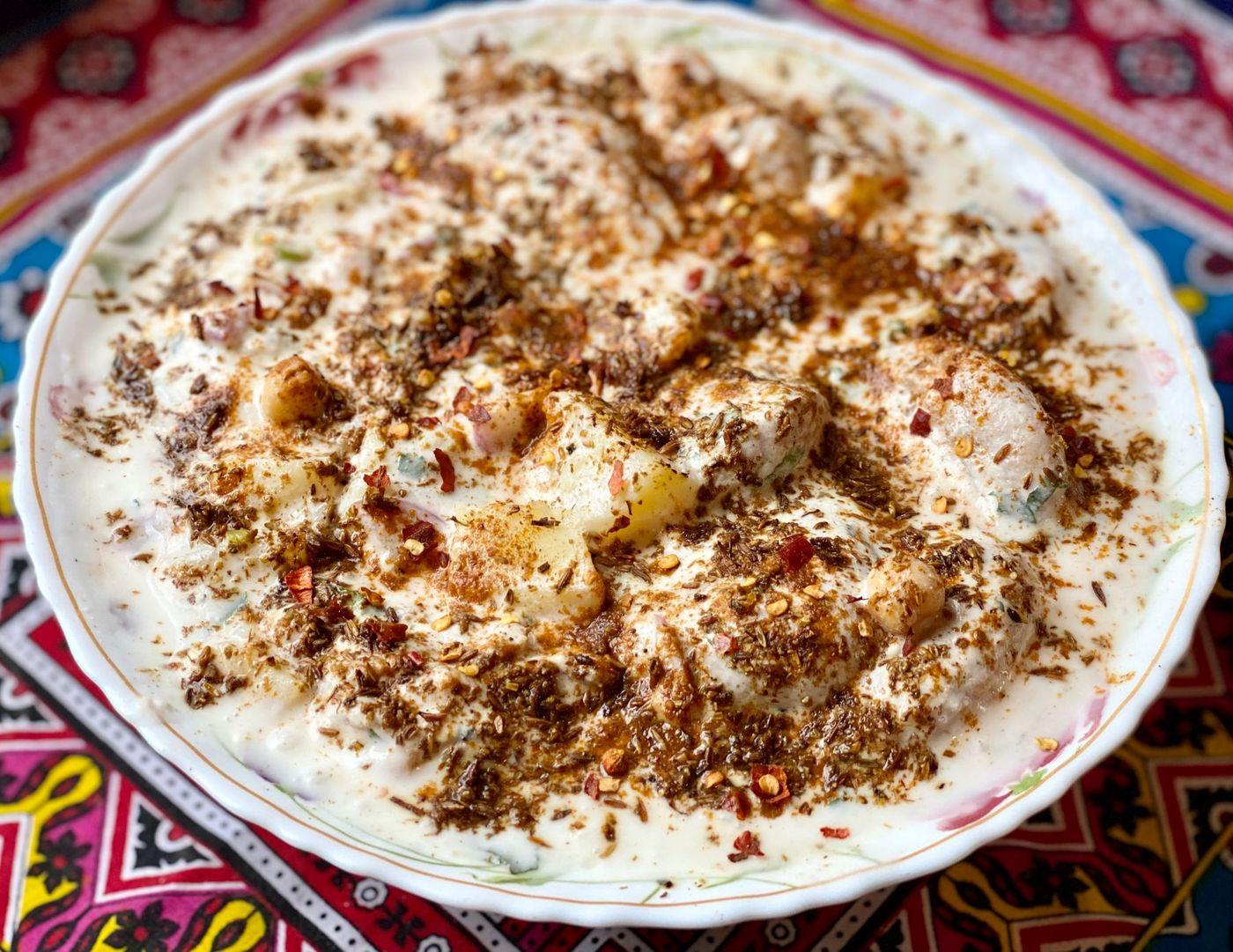
Indian
Dahi Vada
Soft urad dal fritters soaked, then smothered in sweetened yogurt, chutneys and roasted cumin.
83 kcal4 g proteinTime:35 minVegetarianPer serving.
Lentils
Adai
Tamil Nadu · Indian
Adai
Protein-rich Tamil dosa of rice and four dals ground with red chilies, ginger and cumin.
164 kcal6 g proteinTime:30 minVeganPer serving.
Lentils
Aloo Mangodi
Rajasthan · Indian
Aloo Mangodi
Sun-dried moong dal nuggets fried golden, then cooked with potatoes in a thin tomato-yogurt curry.
168 kcal5 g proteinTime:25 minVegetarianPer serving.
Lentils
Bedmi Puri
Delhi and Uttar Pradesh · Indian
Bedmi Puri
Crisp Delhi-style puris with a spiced urad dal and fennel paste kneaded into the wheat dough; eaten with aloo sabzi.
211 kcal7 g proteinTime:40 minVeganPer serving.
Lentils
Cherupayar Curry
Kerala · Indian
Cherupayar Curry
Whole green gram simmered with onion and tomato, finished with fennel-coconut paste and a mustard tempering.
278 kcal13 g proteinTime:40 minVeganPer serving.
Lentils
Cholar Dal
Bengal · Indian
Cholar Dal
Bengal's festive chana dal, sweet and gently spiced, with fried coconut, raisins and garam masala; the partner to luchi.
196 kcal8 g proteinTime:55 minVegetarianPer serving.
Lentils
Dal Dhokli
Gujarat · Indian
Dal Dhokli
Gujarat's Sunday one-pot: spiced wheat-flour diamonds simmered in sweet-sour toor dal with cashews.
340 kcal11 g proteinTime:1 h 5 minVegetarianPer serving.
Lentils
Dal Pakwan
Sindh / Sindhi community · Indian
Dal Pakwan
The Sindhi Sunday breakfast: tangy spiced chana dal with crisp, fried, ajwain-and-pepper pakwan.
571 kcal18 g proteinTime:1 h 30 minVeganPer serving.